
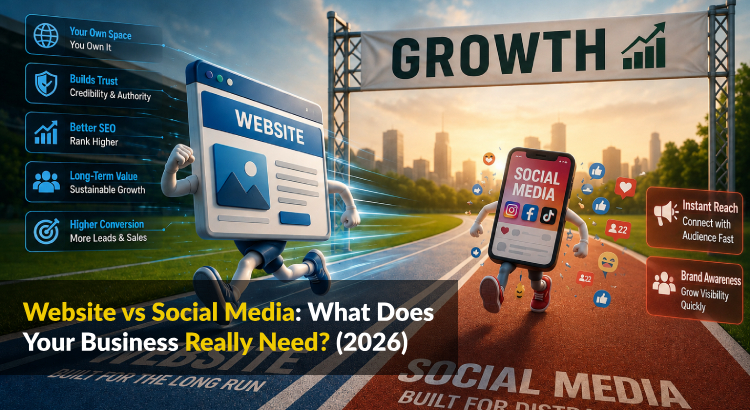
It is one of the most common questions small and medium business owners in India ask when they are thinking about their digital presence — do I need a website, or is social media enough? Some businesses are running entirely on Instagram. Others have websites that nobody visits because all their customers come through Facebook. The confusion is understandable, and the answer is more nuanced than most people expect. If you have been searching for a reliable web design company in Chennai to build your online presence, understanding the real difference between what a website does for your business and what social media does — and why the two are not interchangeable — is the most important starting point.
This guide gives you the honest, complete answer. Not a theoretical one — a practical one that helps you make the right decision for where your business is right now and where it needs to go.
Why This Question Matters More Than Ever in 2026
The rise of Instagram, Facebook, and WhatsApp Business has made it genuinely possible for small businesses in India to generate sales and build an audience with no website at all. This has led many business owners to conclude that a website is optional — an expensive extra rather than a fundamental business requirement.
At the same time, businesses that invest in a professional website without any social media presence often find that the website alone does not generate the visibility and community engagement they expected.
The reality is that both perspectives are partially right and significantly incomplete. Understanding what each channel does well — and where each one falls short — is the only way to make a genuinely informed decision about where to invest your time and money.
What a Website Does for Your Business
It Is a Digital Asset You Own Completely
This is the single most important difference between a website and social media — and it is one that most business owners underestimate until they experience the consequences of ignoring it.
Your website belongs to you. The content on it, the customers who visit it, the data it collects, the traffic it receives — all of it is yours. No platform can change its algorithm and cut your visibility overnight. No policy update can restrict what you post or how you communicate. No account suspension can take your entire digital presence offline without warning.
Social media platforms, by contrast, are digital real estate you are renting — not owning. You are building on land that belongs to someone else, under rules that can change at any time without your input or consent.
It Builds Credibility That Social Media Cannot Replicate
For a significant percentage of customers — particularly in B2B contexts, higher-value purchases, and service industries — a professional website is a credibility requirement, not a nice-to-have. Before engaging a web design agency, a lawyer, a consultant, or a premium product brand, customers will search for the company’s website. If no website exists, many will move on to a competitor who has one.
A professionally designed website communicates that your business is established, serious, and invested in the experience it delivers. An Instagram page, however well maintained, does not carry the same weight for customers making considered purchase decisions. The two channels signal different things about a business’s credibility and permanence.
It Generates Organic Traffic Through SEO
A website, built and optimised correctly, generates free organic traffic from Google indefinitely. Every blog post, every service page, every product page that ranks on Google is a permanent asset that continues attracting visitors and generating enquiries long after it was created — with no ongoing spend required to maintain that visibility.
Social media posts, by contrast, have an average lifespan measured in hours. An Instagram post reaches its audience within the first 24 to 48 hours of posting and then effectively disappears from visibility. The effort invested in creating it does not compound over time the way a well-optimised website page does.
For businesses where customers use Google to find service providers — which describes the majority of B2B and local service categories — SEO-driven website traffic is one of the highest-return marketing investments available.
It Converts Visitors Into Customers More Effectively
A website gives you complete control over the customer journey from the moment someone arrives to the moment they enquire or purchase. You design the layout, the content, the calls to action, the trust signals, the forms, the checkout process — every element of the experience that influences whether a visitor becomes a customer.
Social media platforms constrain this journey significantly. You cannot customise the layout of your profile. You cannot control what a visitor sees alongside your content. You cannot build a checkout flow optimised for your specific product or service. The experience belongs to the platform, not to you.
It Works Around the Clock Without Ongoing Input
A website generates enquiries, captures leads, and processes orders while you sleep — without requiring you to post content, respond to comments, or maintain an active presence. Once built and optimised, it operates as a passive asset that continues working regardless of whether you engage with it daily.
Social media requires constant, ongoing input to remain visible. Stop posting, and your reach drops almost immediately. A website does not punish you for taking a holiday or a busy week away from content creation.
What Social Media Does for Your Business
It Builds Awareness and Community at Scale
Social media’s primary strength is reach — the ability to get your brand in front of large audiences quickly, including audiences who have never searched for what you offer and would never have found you through Google. This top-of-funnel awareness function is something a website alone cannot replicate without significant paid advertising spend.
Instagram, Facebook, and LinkedIn allow businesses to build communities around their brand — audiences that follow, engage, and develop genuine affinity over time. This community-building function creates a warm audience of potential customers who are far more likely to convert when they are ready to purchase than cold traffic from search alone.
It Humanises Your Brand in Real Time
Social media allows businesses to show their personality, their team, their day-to-day reality, and their values in a dynamic, real-time way that a static website cannot match. Behind-the-scenes content, founder stories, customer interactions, and responsive engagement with comments and messages build the kind of human connection that drives genuine brand loyalty.
For small businesses competing against larger, more established players, this humanisation advantage is significant. A big corporation cannot show up on Instagram with the same authenticity as a passionate founder posting from their workshop — and authenticity is one of the most powerful differentiators available to small brands in 2026.
It Drives Fast, Immediate Visibility
A well-executed Reel or viral post can reach tens of thousands of people within 24 hours — a level of immediate visibility that a new website simply cannot achieve through SEO, which takes months to build meaningful traffic. For product launches, promotional events, time-sensitive offers, and brand awareness campaigns, social media delivers speed that no other organic channel matches.
It Enables Direct Customer Conversations
Social media creates a two-way communication channel between businesses and customers that websites do not naturally replicate. Responding to comments, answering DMs, engaging with customer posts — these interactions build relationships and trust that static website content cannot achieve.
For businesses where the sales process involves conversation and relationship building before a purchase decision — which describes most service businesses — this direct engagement function has genuine commercial value.
The Honest Answer: You Need Both — But Not Equally at Every Stage
The framing of website versus social media as an either-or choice is the wrong starting point. They serve fundamentally different functions, and the most effective digital presence in 2026 uses both deliberately — with a clear understanding of what each is being asked to do.
If You Are Just Starting Out
If you are a brand new business with a very limited budget, social media is the faster and lower-cost way to begin building an audience and generating initial sales. Instagram and Facebook can produce results quickly with minimal investment, and the early feedback from social media engagement helps you refine your offering before investing in a more permanent digital infrastructure.
But start planning your website early. The longer you operate without one, the more brand equity and SEO opportunity you are leaving on the table.
If You Are an Established Business Without a Website
If your business has been operating for more than a year and is generating meaningful revenue through social media or marketplace channels but has no professional website, building one is the highest-priority digital investment you can make. You are operating without the credibility asset that a significant percentage of your potential customers are looking for before they decide to trust you with their money.
If You Have a Website but No Social Media Presence
If you have a website but no social media presence, you are missing the community-building, brand humanisation, and rapid awareness functions that social media provides. Even a modest, consistent social media presence — two to three posts per week on the platforms most relevant to your audience — significantly amplifies the reach and impact of the website investment you have already made.
The Ideal Combination
A professional website serves as the anchor of your digital presence — the owned asset that builds SEO authority, captures leads, converts customers, and operates independently of any platform’s algorithm. Social media serves as the discovery and relationship engine — driving awareness, building community, and directing interested audiences toward the website where the conversion happens.
Each channel makes the other more effective. Social media drives traffic to your website. Your website gives social media followers a destination worth visiting. SEO builds website authority that supports paid social performance. The combination, executed consistently, produces results that neither channel can achieve alone.
Common Mistakes Businesses Make With This Decision
Treating social media as a website substitute — Social media can generate sales, but it cannot replace the credibility, SEO value, customer data ownership, and conversion control that a professional website provides. Businesses that rely entirely on social media are building on rented land.
Building a website and ignoring social media entirely — A website without any social media presence misses the community-building and rapid awareness functions that social media uniquely provides. The two channels are complementary, not competitive.
Investing in social media advertising without a website to send traffic to — Paid social advertising drives traffic somewhere. Sending that traffic to an Instagram profile rather than a conversion-optimised landing page on your own website is one of the most common and most costly inefficiencies in small business digital marketing.
Neglecting the website after launch — A website is not a one-time project. It requires ongoing content updates, technical maintenance, and SEO investment to continue performing. Businesses that launch a website and then ignore it consistently underperform those that treat it as a living, evolving asset.
Frequently Asked Questions
Can I run a successful business with only social media and no website?
In the short term, yes — particularly for product-based businesses selling through Instagram or WhatsApp. In the medium to long term, the absence of a website limits your credibility, your SEO visibility, your customer data ownership, and your ability to scale beyond the constraints of platform algorithms. Most businesses that start on social media alone eventually reach a ceiling that only a professional website can break through.
Which social media platform should I focus on for my business in India?
It depends on your audience and your content format. Instagram is most effective for visual product brands and service businesses targeting consumers. LinkedIn is most effective for B2B businesses and professional services. YouTube builds the deepest long-term authority through video content. Facebook remains relevant for local community building and older demographic audiences. Start with one platform, do it well, and expand as your capacity grows.
How much does a professional business website cost in Chennai?
A professionally designed business website in Chennai typically starts from ₹15,000 to ₹40,000 for a well-built, mobile-optimised site. E-commerce websites and more complex builds range higher depending on scope and functionality. The investment should be evaluated against the revenue impact of having a credible, search-visible digital presence rather than as a standalone cost.
Does having a website help my social media performance?
Yes, indirectly. A website with strong SEO authority builds brand credibility that improves social media trust. Website content — blog articles, case studies, guides — provides valuable material to share on social media that is more substantial than what most businesses produce natively for social platforms. And social media traffic directed to your website builds the engagement signals that support SEO performance over time.
How long does it take for a new website to start generating traffic?
Organic traffic from SEO typically begins to show meaningful results within 3 to 6 months of consistent optimisation effort. Paid traffic from Google Ads or social media advertising can drive visitors from day one. The combination of both — paid traffic for immediate results while SEO builds for long-term compounding growth — is the approach most recommended for businesses that need results quickly without sacrificing sustainable visibility.
Final Thoughts
The question is not website or social media. The question is how to use both intelligently to build a digital presence that is owned, credible, discoverable, and genuinely effective at converting interest into revenue.
Social media is powerful — for awareness, community, and speed. A website is essential — for credibility, SEO, customer ownership, and long-term business value. Together, they create a digital presence that is greater than the sum of its parts.
If you are choosing between the two because budget constrains you to one, start with social media for immediate traction and plan your website as the next investment. If budget allows both, build the website correctly from the start and use social media to amplify everything it does.
Either way — start. The businesses building strong digital foundations today are the ones that will be impossible to displace tomorrow.
DREAM EFFECTS
Ready to build a digital presence that works on every front?
We work with businesses across Chennai and India — building professional websites that rank on Google, convert visitors into customers, and serve as the anchor for a complete digital marketing strategy. Whether you need a website built from scratch, a social media strategy to complement it, or both working together as a unified growth engine, we will give you an honest plan built around your specific business goals.