
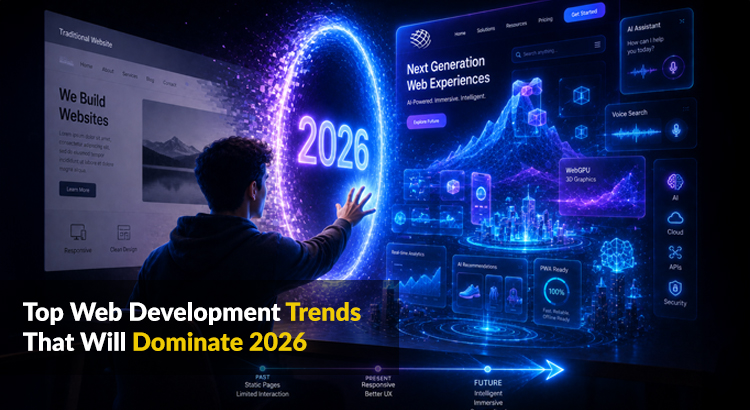
The web development landscape changes faster than almost any other area of technology — and the businesses that stay ahead of these changes consistently outperform those that do not. What worked well for a website three years ago may be actively working against you today. If you have been looking for a reliable web development company in Chennai to build or modernise your digital presence, understanding the trends shaping web development in 2026 will help you ask the right questions, make smarter decisions, and ensure your investment delivers genuine long-term value.
This guide covers the most significant web development trends of 2026 — what they are, why they matter, and what they mean practically for businesses investing in their online presence this year.
Why Keeping Up With Web Development Trends Matters for Business
Web development trends are not abstract technical curiosities. They are the practical evolution of how websites are built, how they perform, how they rank on Google, and how they convert visitors into customers.
A website built without awareness of current standards will underperform on page speed benchmarks that Google uses as ranking signals. It will deliver a substandard experience on mobile devices that now account for the majority of web traffic in India. It will lack the security standards that modern users expect and regulators increasingly require.
Staying current with web development trends is not about chasing novelty — it is about ensuring your website continues to perform competitively in an environment that keeps moving forward regardless of whether your own digital presence moves with it.
10 Web Development Trends Dominating 2026
1. AI-Powered Web Development and Design
Artificial intelligence has moved from a peripheral tool to a central part of how professional websites are built in 2026. AI assists developers in writing cleaner, faster code. It accelerates UI design by generating layout options, colour schemes, and component variations from simple prompts. It powers testing by automatically identifying usability issues, accessibility violations, and performance bottlenecks before a site launches.
For businesses, the practical impact is significant. AI-assisted development reduces the time and cost of building high-quality websites without reducing quality. Projects that would previously have required weeks of iteration can move faster, with more options explored and more problems identified early in the process.
AI is also changing how websites behave for users — personalising content in real time based on visitor behaviour, adjusting product recommendations dynamically, and serving different experiences to different audience segments automatically. The result is a website that feels more relevant to every individual visitor rather than delivering a one-size-fits-all experience.
2. Core Web Vitals and Performance-First Development
Google’s Core Web Vitals — Largest Contentful Paint, Cumulative Layout Shift, and Interaction to Next Paint — are now established, well-understood ranking signals that directly influence where your website appears in search results. In 2026, performance-first development is not a trend in the sense of something new and emerging. It is the baseline standard that every professionally built website must meet.
What is evolving is how rigorously these standards are being applied and how the metrics themselves are being refined. Developers are increasingly building performance budgets into projects from the start — setting hard limits on page weight, image sizes, and script loading that keep Core Web Vitals scores in the passing range throughout development rather than attempting to fix performance after the fact.
For businesses, this means that when briefing a web development project in 2026, Core Web Vitals targets should be specified requirements, not aspirational afterthoughts. A website that fails these benchmarks at launch is underperforming from day one.
3. Mobile-First Development as Standard Practice
Mobile-first is no longer a trend — it is the only rational development approach for any business with Indian customers. Mobile devices account for the majority of web traffic in India across virtually every industry and demographic. Google’s mobile-first indexing means the mobile version of your website is what Google primarily evaluates when determining your search rankings.
What is evolving within mobile-first development in 2026 is the increasing sophistication of mobile user experience expectations. Visitors on mobile now expect experiences that are not just functional on a small screen but genuinely optimised for touch navigation, thumb-friendly interface design, fast loading on variable mobile network connections, and progressive enhancement that delivers core functionality even under constrained conditions.
Businesses whose websites were built with mobile as an afterthought — scaled down from a desktop design rather than built from mobile upward — are consistently outperformed by competitors whose mobile experience is genuinely native rather than adaptive.
4. Headless and Composable Architecture
Headless web development separates the front end of a website — what visitors see and interact with — from the back end content management system that stores and manages content. Rather than using a traditional CMS that controls both content and presentation, a headless approach delivers content through APIs to any front-end framework, enabling significantly faster performance, greater design flexibility, and the ability to deliver the same content across websites, mobile apps, and other digital channels simultaneously.
For e-commerce businesses in particular, headless commerce is becoming increasingly attractive as an alternative to the limitations of traditional platform-dependent stores. Headless e-commerce delivers the design freedom and performance advantages of a custom-built front end with the robust commerce functionality of established platforms handling the back end.
The practical consideration for businesses is that headless architecture involves greater initial complexity and development investment than traditional CMS-based websites. It makes the most sense for businesses with significant traffic, complex content requirements, or the need to deliver consistent experiences across multiple digital channels simultaneously.
5. Progressive Web Applications
Progressive Web Applications bridge the gap between websites and native mobile apps — delivering app-like experiences through the browser without requiring users to visit an app store or install anything on their device. PWAs load instantly, work offline or on poor network connections, send push notifications, and can be added to a device’s home screen for quick access.
For Indian businesses with customers on slower mobile connections or lower-specification devices, PWAs offer a particularly compelling advantage. The ability to function meaningfully in low-connectivity environments dramatically expands the effective audience for a digital experience that a standard website would fail to serve adequately.
E-commerce businesses, news publishers, service booking platforms, and any business model that benefits from repeat mobile visits and push notification marketing are the strongest candidates for PWA development in 2026.
6. Advanced Personalisation Through Data and AI
Static websites that present the same experience to every visitor regardless of who they are, where they came from, or what they have previously done are increasingly at a disadvantage against websites that adapt dynamically to individual visitors.
Advanced personalisation in 2026 uses a combination of behavioural data, session context, and AI to serve different content, product recommendations, calls to action, and even pricing to different visitor segments in real time. A returning customer sees different messaging than a first-time visitor. A visitor who previously browsed a specific product category sees relevant content surfaced prominently. A visitor arriving from a specific geographic region sees locally relevant offers and content.
The technology enabling this has become significantly more accessible in 2026 — no longer requiring enterprise-level investment to implement meaningful personalisation that measurably improves conversion rates.
7. Voice Search Optimisation
Voice search has grown steadily as smart speakers, voice assistants, and voice-enabled mobile search become more deeply embedded in everyday behaviour. In India specifically, voice search in regional languages — Tamil, Hindi, Telugu, and others — is growing significantly as voice recognition accuracy in these languages improves.
Voice search optimisation requires a different approach to content than traditional text-based SEO. Voice queries are conversational and question-based rather than keyword-based. Content structured to answer specific questions directly and concisely — particularly in formats that Google’s featured snippets favour — captures voice search traffic more effectively than content written purely for text search.
For businesses with local customer bases, voice search optimisation for queries like “best web development company near me” or location-specific service searches is becoming an increasingly important component of a comprehensive SEO strategy.
8. Enhanced Cybersecurity Standards
Security requirements for websites are increasing in 2026 — driven by rising threat sophistication, growing regulatory requirements, and increasing customer awareness of data privacy. What constituted adequate security three years ago may no longer meet current standards or customer expectations.
Key security developments shaping web development in 2026 include more widespread adoption of zero-trust security architectures, stronger content security policies that limit the attack surface of web applications, enhanced data encryption standards, and more rigorous handling of third-party scripts and integrations that introduce security vulnerabilities.
For businesses, the practical implication is that security specifications should be an explicit part of every web development brief rather than an assumed default. Ask specifically about security architecture, update management processes, and ongoing monitoring before engaging any development partner.
9. Sustainable and Green Web Development
Digital infrastructure has a significant and growing environmental footprint. Data centres consume enormous amounts of energy, and every inefficient, bloated website that requires more server processing and data transfer than necessary contributes to that footprint.
Green web development — building websites that are lighter, faster, and more energy-efficient — is gaining genuine momentum in 2026, driven both by environmental consciousness and the practical reality that lighter, more efficient websites are also faster websites that perform better on Core Web Vitals and deliver better user experiences.
For businesses with sustainability commitments or environmental values that are part of their brand positioning, green web development practices offer an opportunity to align digital infrastructure with brand values in a way that is increasingly visible and valued by customers.
10. API-First Development and Third-Party Integrations
Modern business websites are rarely standalone entities — they are connected to CRMs, marketing automation platforms, inventory systems, payment gateways, analytics tools, and an expanding ecosystem of business software. API-first development treats these integrations as core architectural considerations from the start rather than bolt-on additions attempted after the primary build is complete.
In 2026, the expectation for professionally built business websites is that they integrate cleanly and reliably with the business systems that surround them. A website that cannot connect to your CRM means manual data entry. A checkout that does not integrate cleanly with your inventory system creates fulfilment errors. An analytics setup that does not connect to your marketing platforms means decisions made on incomplete data.
Building API-first — designing the integration architecture before writing front-end code — produces more reliable, more maintainable, and more scalable websites than the alternative of retrofitting integrations into a structure that was not designed to accommodate them.
What These Trends Mean for Businesses Planning a Website Project in 2026
The collective implication of these trends for any business planning a web development project this year is straightforward: the standard for what a professionally built website looks like, performs like, and is capable of has risen significantly.
A website built without performance-first thinking will underperform on Core Web Vitals. A website built without mobile-first design will deliver a substandard experience to the majority of your visitors. A website built without considering AI personalisation, voice search, or API integrations will require significant additional investment to add these capabilities later.
The most cost-effective approach is to build correctly from the start — specifying current standards as requirements, working with a development partner who understands and applies them, and investing in a foundation that does not need to be rebuilt again in two years.
Frequently Asked Questions
Do these web development trends apply to small businesses or just large enterprises?
These trends apply to businesses of all sizes, though the priority and depth of implementation varies. Core Web Vitals performance, mobile-first design, and security standards are baseline requirements for every business website regardless of size. More complex capabilities like headless architecture or advanced AI personalisation are most appropriate for businesses with larger traffic volumes and more complex requirements.
How do I know if my current website is keeping up with 2026 standards?
Test your website against Google PageSpeed Insights for performance, Google’s Mobile-Friendly Test for mobile usability, and review your Google Search Console Core Web Vitals report. If your site is more than three years old, a professional audit will quickly identify where it falls short of current standards and what the highest-priority improvements are.
Is it better to update my existing website or build a new one?
This depends on how far the existing site falls from current standards and how much technical debt it has accumulated. If the underlying architecture is sound and the gaps are addressable through targeted improvements, an upgrade may be the right approach. If the site is built on outdated technology, has significant performance issues, or cannot support the integrations your business needs, a rebuild on a modern foundation is typically the better long-term investment.
How long does a modern website build take in 2026?
A professionally built business website typically takes 6 to 10 weeks from discovery to launch. More complex projects involving custom functionality, e-commerce, or multiple integrations may take 3 to 6 months. Rushing a web development project to meet an arbitrary deadline consistently produces websites that require expensive remediation shortly after launch.
Final Thoughts
Web development in 2026 is defined by higher performance standards, smarter user experiences, tighter security requirements, and a deeper integration between websites and the broader business systems they support. The businesses that invest in websites built to these standards will outperform, outrank, and out-convert competitors whose digital presence is built on older foundations.
The trends covered in this guide are not predictions about a distant future — they are the current reality of what professional web development looks like today. Building to these standards is not optional for businesses that want to compete effectively online. It is the entry requirement for the game.
DREAM EFFECTS
Ready to build a website that meets 2026 standards from day one?
We are a web development company working with businesses across Chennai and India — building fast, secure, mobile-first websites and e-commerce stores that are designed to perform, rank, and convert from the moment they launch. Whether you are starting a new project or modernising an existing site, we will give you an honest assessment of what your business actually needs.