
Think about your best salesperson. They know your product inside out, they build trust quickly, they answer every question a customer could possibly have, and they close deals consistently. Now imagine that salesperson working every hour of every day — no salary, no sick days, no off days — reaching every potential customer who comes looking for what you offer. That is exactly what your website is supposed to be. If you have been looking for the right web design company in Chennai to build or improve your online presence, the most important question to ask before anything else is this — is my website actually doing its job, or is it just sitting there looking the part?
Most business websites in India fall into the second category. They exist. They load. They have the right pages. But they are not selling. They are not converting. They are not doing the one thing a website fundamentally exists to do — turn visitors into customers.
What a Salesperson Does That Your Website Should Too
A great salesperson does not just talk about the product. They read the room. They address objections before the customer voices them. They build enough trust that the customer feels confident making a decision. They make the next step obvious and easy. Every element of that process has a direct equivalent in how a high-performing website is designed and built.
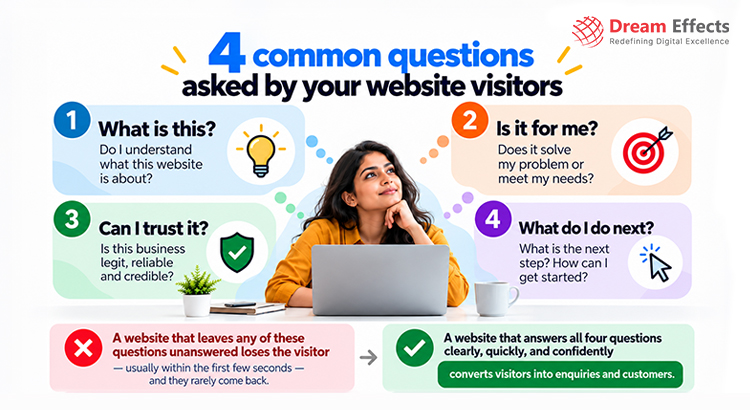
When a visitor lands on your website, they are asking four questions almost immediately — often without realising it. What is this? Is it for me? Can I trust it? What do I do next? A website that answers all four questions clearly, quickly, and confidently converts visitors into enquiries and customers. A website that leaves any of them unanswered loses the visitor — usually within the first few seconds — and they rarely come back.
Why Most Business Websites Fail as Salespeople
The most common reason business websites underperform has nothing to do with design. It has to do with clarity. Most websites are written and structured from the business owner’s perspective — showcasing what the business does, how long it has been operating, what services it offers — rather than from the customer’s perspective, which is the only perspective that actually matters when someone is deciding whether to enquire or buy.
A visitor does not care how many years you have been in business until they first understand why any of that is relevant to their specific problem. They do not care about your company history until they are convinced you can solve what they came looking for. Leading with your credentials before establishing your relevance is the single most common and most damaging structure mistake business websites make.
The second most common failure is weak or absent calls to action. A visitor who is genuinely interested in what you offer and cannot immediately see what to do next will leave. Not because they are not interested — because you made the next step unclear. Every page on your website should have one obvious, compelling next step designed around what the visitor wants to do, not what you want to tell them.
The Signs Your Website Is Not Pulling Its Weight
You do not need a technical audit to identify a website that is not performing. The signs are visible in your business metrics long before anyone checks a heatmap or a bounce rate report.
If your website gets reasonable traffic but your enquiry volume does not reflect it, your website has a conversion problem. If customers regularly ask you questions that your website already answers — or should answer — your website has a clarity problem. If visitors arrive from Google or social media and leave within seconds, your website has a relevance or speed problem. And if you feel embarrassed sharing your website link with a potential client because you know it does not reflect the quality of work your business actually delivers, that feeling is the most honest signal of all.
A website that makes you hesitate before sharing it is not doing its job.
What a High-Performing Website Actually Looks Like
Speed is the first filter. If your pages take more than three seconds to load on mobile — which is where the majority of your visitors in India are coming from — a significant percentage of them leave before seeing anything. No design, no copy, no offer matters if the page never finishes loading. Speed is not a technical nicety. It is the entry requirement for everything else on this list to matter.
Clarity is the second filter. The moment a visitor arrives, they should understand exactly what you do, who you do it for, and why you are the right choice — without scrolling, without reading every word, without working for it. If your homepage headline is your company name or a vague tagline that could apply to any business in your category, you have already lost a significant portion of the visitors who were genuinely looking for what you offer.
Trust is what converts interest into action. Testimonials from real customers, case studies with specific results, recognisable client logos, certifications, and a transparent and professional presentation of who is behind the business — these are the signals that take a visitor from interested to confident enough to make contact or place an order. Trust signals are not decoration. They are the mechanism by which a website closes the gap between attention and action.
Mobile experience is not optional. A website that works beautifully on a desktop and breaks, squishes, or frustrates on a smartphone is a website that is actively failing the majority of its visitors in India. Every element of the experience — navigation, forms, buttons, page structure, load time — needs to work as well on a four-inch screen as on a fifteen-inch monitor.
And the call to action is what everything else builds toward. Every page should guide the visitor toward one clear next step — call now, get a quote, book a consultation, shop the collection, download the guide. One action. Made obvious. Made easy. Made compelling. Websites that scatter five different calls to action across a page or bury the enquiry form at the bottom after three screens of company history are doing the equivalent of a salesperson who spends the entire conversation talking about themselves and forgets to ask for the sale.
The Business Cost of a Website That Is Not Selling
Every visitor who arrives on your website and leaves without taking action represents a cost. Either you paid to acquire that visitor through advertising, or you invested in SEO to earn that organic visit, or someone referred them and your website failed to capitalise on that warm introduction. The cost of a poorly performing website is not the cost of building it. It is the compounded cost of every missed conversion across every visitor it fails to engage, every month it continues underperforming.
For a business receiving 1,000 website visitors per month with a conversion rate of 0.5% — well below what a well-optimised website should achieve — that is 995 visitors leaving without becoming leads. Move that conversion rate to 3% through better design, faster speed, clearer messaging, and stronger calls to action, and you have gone from 5 enquiries per month to 30 — from the same traffic, with no increase in advertising spend. That is the commercial case for taking your website’s performance seriously.
What to Do If Your Website Is Not Performing
Start with an honest audit. Look at your website the way a first-time visitor would — someone who has never heard of your business and arrived from a Google search. Does the homepage immediately communicate what you do and who it is for? Does it load quickly on your mobile phone? Is there an obvious next step? Do the testimonials and trust signals feel real and compelling or generic and unconvincing?
Then look at your data. Google Analytics will show you where visitors are dropping off. Google Search Console will show you whether you are ranking for the terms your customers are actually searching. PageSpeed Insights will show you your Core Web Vitals scores and exactly what is slowing your pages down.
If the audit reveals fundamental problems — unclear messaging, poor mobile experience, slow page speed, no conversion architecture — a redesign is almost certainly the right investment. Not because something looks dated, but because something is not working. And in business, a primary sales channel that is not working is not a cosmetic problem. It is a revenue problem.
Frequently Asked Questions
How do I know what conversion rate my website should be achieving?
Conversion rates vary by industry and traffic source, but most professional business websites should be converting between 2% and 5% of visitors into enquiries or leads. E-commerce stores typically convert between 1% and 3% of visitors into purchases. If your current rate is significantly below these benchmarks, there is a clear and addressable performance gap.
Does improving my website design automatically improve conversions?
Design alone does not drive conversions — clarity, speed, trust signals, and strong calls to action do. A beautifully designed website with vague messaging and no clear next step will underperform a plainer website with sharp messaging and an obvious enquiry path. Good design supports conversion when it serves the communication strategy rather than replacing it.
How often should I review my website’s performance?
At minimum quarterly. Google Analytics and Search Console give you the data you need to assess whether traffic is growing or declining, where visitors are dropping off, and which pages are generating the most enquiries. Monthly reviews are better for businesses where the website is a primary revenue channel.
Can small changes make a significant difference to conversion rates?
Yes — and often dramatically. Changing a headline to address the customer’s problem directly rather than leading with the company name, moving the enquiry form above the fold, adding two or three specific client testimonials, and improving page load speed can collectively double or triple conversion rates without a full redesign.
Final Thoughts
Your website is either your most productive salesperson or your most expensive piece of digital furniture. The difference between the two is not how it looks — it is whether it is built around the customer’s journey, answers their questions before they ask them, earns their trust before asking for their business, and makes the next step impossible to miss.
Every day your website underperforms is a day your competitors are capturing the customers it is failing to convert. The good news is that the gap between a website that sits there and a website that sells is almost always closeable — with the right strategy, the right design decisions, and the right development partner who understands that a website’s only real job is to grow your business.
DREAM EFFECTS
Is your website working as hard as you are?
We build websites for businesses across Chennai and India that are designed from the ground up to attract the right visitors, earn their trust, and convert them into customers. If your current website is not performing the way your business deserves, we will audit it honestly and tell you exactly what needs to change.