
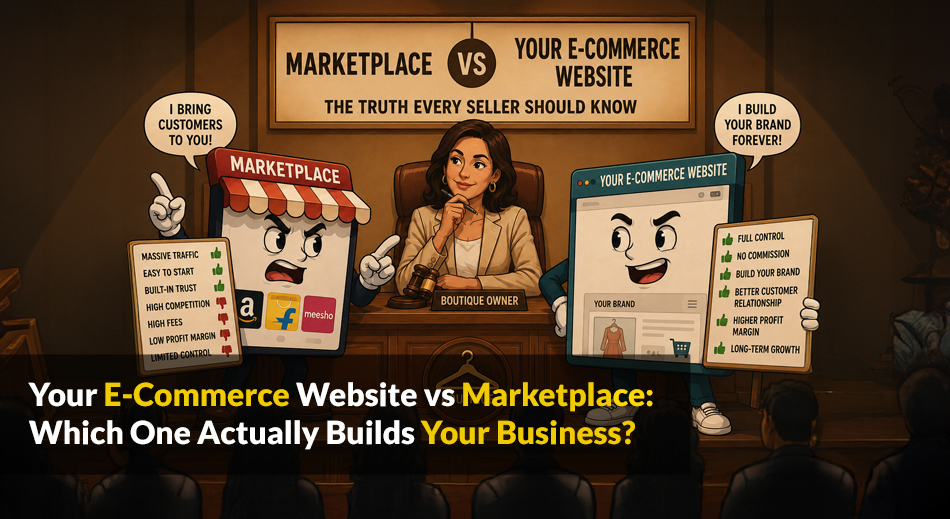
If you are selling on Amazon, Flipkart, Meesho, or any other marketplace in India, you already know the advantages — ready-made traffic, built-in trust, and a relatively straightforward setup process. What most sellers do not fully account for until it is too late are the hidden costs, the structural limitations, and the very real risks of building an entire business on a platform you do not own and cannot control. If you have been considering working with an ecommerce website development company in Chennai to build your own store, this guide will give you the honest, complete picture that marketplace success stories rarely tell — and help you make the most informed decision for your business.
The choice between marketplace selling and owning your own website is one of the most consequential decisions an online seller can make. It determines your margins, your customer relationships, your brand equity, and ultimately your ability to build a business that you actually own rather than one that exists at the pleasure of a platform’s algorithm.
What Marketplaces Give You — And What They Take
Marketplaces offer genuine advantages, particularly in the early stages of building an online selling business. Understanding both sides of this equation clearly is the only way to make a genuinely informed decision.
What Marketplaces Give You
Immediate traffic — Amazon and Flipkart receive tens of millions of visitors every month. Listing a product on these platforms gives you immediate access to an audience that would take years and significant investment to build independently.
Built-in trust — Customers trust established marketplace brands. A first-time buyer who has never heard of your brand will purchase from your marketplace listing with far less hesitation than they would from an unfamiliar standalone website.
Operational infrastructure — Fulfilment networks, payment processing, customer service systems, and return handling are either provided or simplified by marketplace infrastructure, reducing the operational complexity of starting out.
Lower initial investment — Getting started on a marketplace requires significantly less upfront investment than building and marketing your own website from scratch.
What Marketplaces Take From You
A significant percentage of every sale — Marketplace commissions in India typically range from 5% to 40% depending on the category. Add fulfilment fees, advertising costs to remain visible, return handling charges, and promotional participation fees, and the actual margin retained per sale is often dramatically lower than sellers initially calculate.
Your customer relationships — Every customer who buys from your marketplace listing belongs to the marketplace, not to you. You cannot contact them, cannot build a relationship with them, cannot market to them directly, and cannot bring them back for a repeat purchase without going through the marketplace again — and paying again for that visibility.
Your brand identity — On a marketplace, your product exists within a standardised template alongside dozens of competing products. The customer experience is the marketplace’s experience, not yours. Building genuine brand recognition in this environment is structurally very difficult.
Your business security — Marketplace sellers operate at the complete discretion of platform policies that can change at any time. Accounts can be suspended, listings can be removed, commission structures can change, and algorithm shifts can eliminate your visibility overnight — without warning and without meaningful recourse.
The Real Cost of Marketplace Dependency
The mathematics of marketplace selling are worth examining honestly, because the full cost picture is rarely visible in the headline commission rate.
Consider a product selling at ₹1,000 on a major Indian marketplace in a mid-range commission category:
Marketplace commission (18%): ₹180 Fulfilment and shipping fees: ₹80 to ₹120 Return handling (industry average return rate 15–20%): ₹30 to ₹50 per unit sold Marketplace advertising (required to maintain visibility in competitive categories): ₹50 to ₹150 per sale Payment processing and settlement delays: 7 to 14 day cash flow impact
Before accounting for product cost, packaging, or any other business overhead, a seller on a major Indian marketplace in a competitive category may be retaining as little as ₹400 to ₹600 of a ₹1,000 sale — a 40% to 60% cost of selling that compounds at scale.
The same product sold through your own website, with your own payment gateway and your own fulfilment, typically incurs a total transaction cost of 3% to 5% — a difference that at meaningful volume translates to lakhs of rupees in retained margin annually.
The Risks Every Marketplace Seller Needs to Understand
Platform Risk Is Real and Underestimated
Marketplace sellers across India have experienced firsthand the consequences of platform dependency. Policy changes that altered commission structures overnight. Algorithm updates that buried listings that had previously generated consistent sales. Account suspensions triggered by competitor complaints that took weeks or months to resolve — during which time businesses generated zero revenue from the platform.
Every sale you make on a marketplace is building the marketplace’s business as much as your own. The customer data, the purchase history, the brand familiarity — all of it accrues to the platform. When the platform’s interests and your interests diverge — and they eventually will — the platform’s interests win. This is not a criticism of any specific marketplace. It is simply the structural reality of building your primary business on someone else’s platform.
You Are Always One Algorithm Change Away From Irrelevance
Marketplace visibility is determined by algorithms that rank products based on factors including sales velocity, review count, advertising spend, and pricing competitiveness. When these algorithms change — and they change regularly — sellers who have not built any presence outside the marketplace have no fallback.
Sellers who have built their own websites, their own email lists, their own social media communities, and their own SEO presence alongside their marketplace activity have multiple channels generating sales. When one channel underperforms, the others continue. This diversification is not just good business practice — it is fundamental business resilience.
Marketplaces Can Become Your Competitor
Several major marketplaces now operate their own private label product lines that compete directly with third-party sellers in the same categories. When the platform decides to launch its own version of a product you are successfully selling, it has access to your sales data, your pricing history, and your category insights — and it can use all of it to compete against you while simultaneously controlling the algorithm that determines your visibility.
Why Your Own Website Changes the Business Equation
Building your own e-commerce website does not mean abandoning marketplace sales — the most successful Indian online sellers use both in combination. What it means is building an asset that you own, that builds equity over time, and that cannot be taken away by a platform policy change.
You Own Your Customer Relationships
Every customer who purchases through your own website gives you a direct relationship — their email address, their purchase history, their preferences, their contact details. You can market to them directly, bring them back for repeat purchases at zero acquisition cost, ask for reviews, offer loyalty rewards, and build the kind of relationship that creates genuine brand advocates rather than anonymous marketplace transactions.
The lifetime value of a customer you own is dramatically higher than the lifetime value of a marketplace customer you will never hear from again unless they happen to find your listing on their next search.
Your Margins Are Fundamentally Different
At the transaction cost difference between marketplace selling and direct e-commerce — often 35% to 55% of sale value versus 3% to 5% — the financial case for building your own website becomes compelling at almost any meaningful volume. The investment in building and marketing your own store is recovered in retained margin surprisingly quickly once direct sales reach a consistent level.
You Build a Brand, Not Just a Product Listing
Your own website gives you complete control over the customer experience — the design, the story, the packaging presentation, the post-purchase communication, the loyalty programme, the content that positions you as an authority in your category. None of this is possible within the standardised template of a marketplace listing.
Brand equity built through your own digital presence is a genuine business asset that increases in value over time. It commands premium pricing, creates customer loyalty that is not price-dependent, and is ultimately what makes a business acquirable if you ever choose to sell.
SEO Builds a Free Traffic Engine
A well-optimised e-commerce website generates organic search traffic that costs nothing per click once earned. A marketplace listing generates no SEO value for your own business — every click belongs to the marketplace. Investing in SEO for your own website builds a compounding traffic asset that delivers increasingly cost-efficient customer acquisition over time.
For businesses in India targeting specific product categories, ranking on Google for relevant product searches delivers high-intent traffic directly to your store — bypassing the marketplace entirely and keeping 100% of the margin.
The Smartest Approach: Use Both Strategically
The most successful Indian online sellers in 2026 are not choosing between marketplaces and their own websites. They are using both strategically, with a clear understanding of what each channel does well.
Marketplaces serve as discovery channels — reaching customers who have never heard of the brand and converting them to first-time buyers at scale, accepting the lower margins as a customer acquisition cost.
Your own website serves as the retention and relationship channel — where repeat customers, direct marketing, loyalty programmes, and brand-building activity happen at full margin, building the equity and resilience that a marketplace-only business can never have.
The practical execution of this dual-channel strategy requires directing marketplace customers toward your own website through packaging inserts, follow-up communication where permitted, and building enough brand recognition that customers seek you out directly for repeat purchases.
What to Look for When Building Your Own E-Commerce Website
Not all e-commerce websites deliver equal results. These are the non-negotiable elements of an e-commerce website that is genuinely built to perform.
Mobile-first design — The majority of Indian online shoppers browse and purchase on mobile. A website that is not genuinely optimised for mobile shopping will underperform regardless of its desktop experience.
Fast page loading — E-commerce conversion rates drop significantly with every additional second of load time. Core Web Vitals compliance is a minimum standard, not an aspiration.
Secure and trusted checkout — SSL, recognised payment gateways like Razorpay and PayU, and a professional checkout experience that removes anxiety at the highest-intent moment in the customer journey.
SEO architecture — Product pages, category pages, and URL structures built for search engine visibility from day one, not retrofitted after launch.
Inventory and order management — Systems that scale with your business without creating operational chaos as volume grows.
Analytics and conversion tracking — Complete visibility into where your traffic comes from, where it drops off, and which products and pages drive the most revenue.
Frequently Asked Questions
Can I run my own website and marketplace stores simultaneously? Absolutely — and this is the approach most recommended for established sellers. Marketplaces drive discovery and new customer acquisition. Your own website builds the customer relationships, margin, and brand equity that create a genuinely valuable long-term business.
How much does it cost to build an e-commerce website in Chennai? The cost varies significantly based on scope and complexity. A professionally built e-commerce store in Chennai typically starts from ₹40,000 to ₹80,000 for a well-designed, fully functional store. More complex custom builds with advanced functionality range higher. The investment is typically recovered through retained margin within the first few months of meaningful direct sales volume.
How long does it take to start getting sales from my own website? Organic traffic through SEO takes 3 to 6 months to build meaningfully. Paid advertising can drive traffic from day one. Most businesses that launch their own website alongside continued marketplace activity see a meaningful shift in the balance of direct versus marketplace sales within 6 to 12 months of consistent marketing effort.
Which e-commerce platform should I use for my own website? The right platform depends on your product range, technical requirements, and growth plans. WooCommerce, Shopify, and custom-built solutions each have distinct advantages depending on your specific situation. A detailed comparison is available in our guide on WooCommerce vs Shopify vs Custom E-Commerce to help you make the right choice for your business.
Will building my own website hurt my marketplace sales? No — operating your own website does not affect your marketplace listings or performance in any way. The two channels operate entirely independently. The risk runs in the other direction: marketplace dependency without a direct channel leaves your business vulnerable to platform changes that your own website provides protection against.
Final Thoughts
Marketplaces are powerful tools — but they are tools, not foundations. A business built entirely on marketplace selling is a business built on land it does not own, with a customer base it cannot reach, a brand it cannot fully build, and a revenue stream that can be disrupted by decisions made in a boardroom it has no influence over.
The sellers who will lead their categories in India over the next five years are the ones building direct customer relationships, brand equity, and organic traffic through their own digital presence — while using marketplaces intelligently as one channel among several rather than the only channel that matters.
Your own website is not a threat to your marketplace success. It is the foundation that makes your marketplace success sustainable.
DREAM EFFECTS
Ready to build an online store you actually own?
We build e-commerce websites for businesses and sellers across Chennai and India — stores that are fast, secure, mobile-first, and built to rank on Google and convert visitors into customers from day one. Whether you are moving beyond marketplaces for the first time or scaling a direct channel alongside existing marketplace sales, we will give you an honest assessment of what your store needs to succeed.