
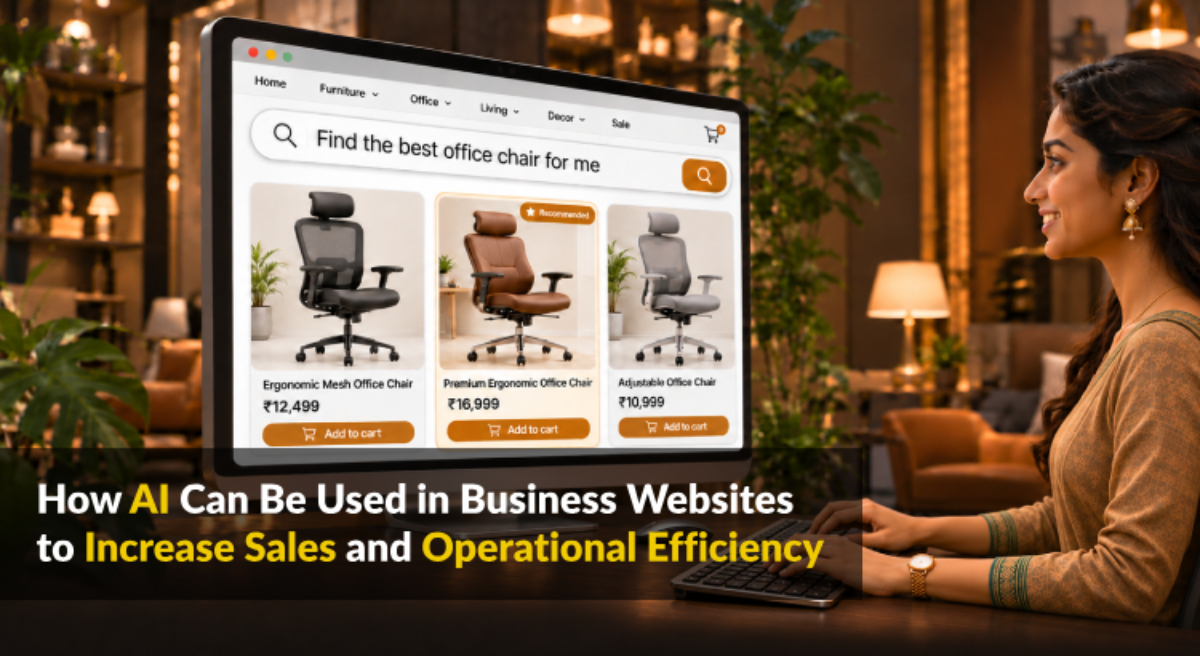
Your website may attract visitors every day. But how many leave because they cannot find the right product, get an immediate answer or understand what to do next?
For your team, the same gaps create extra work: answering repeated questions, sorting enquiries and manually transferring information between systems.
AI for business websites can help address both problems. When connected to accurate business information and the right workflows, artificial intelligence can guide visitors towards a purchase while reducing repetitive administrative tasks.
For businesses across industries, this creates an opportunity to turn a website into a more effective sales and service channel. The starting point is choosing AI features that solve a specific customer or operational problem.
What Is AI Integration in a Business Website
AI website integration means connecting artificial intelligence tools to your website, product catalogue or business systems to perform useful tasks.
These tasks might include answering questions, understanding a visitor’s search, recommending suitable products or summarising a sales enquiry.
For example, a conventional contact form collects a visitor’s name and phone number. An AI assistant could also ask what service they need, capture their requirements and prepare a summary for the sales team.
Some website automation does not require AI. Sending a form submission to an email address is a standard automated workflow. Understanding a detailed customer message and identifying its likely intent is where AI can add value.
The strongest solutions combine both: AI interprets the request, while controlled workflows handle the next steps.
How AI Can Help Business Websites Increase Sales
1. Answer Customer Questions When Interest Is Highest
A visitor comparing products may need a quick answer about size, delivery or compatibility. A potential client may want to know whether your company handles a particular type of project.
An AI chatbot for business can answer common questions using approved website content, product information and business policies.
For example, a hospitality business could answer questions about facilities and availability, while a manufacturer could explain product specifications and service coverage.
This can reduce the uncertainty that causes visitors to abandon an enquiry or purchase.
What makes it work: reliable information, clear limits and an easy handover to a person when the assistant cannot answer confidently.
2. Help Visitors Find Suitable Products
Customers do not always know the exact words used in your catalogue.
Someone might search for “comfortable office chair for long working hours” instead of a specific product name. AI-powered website search can interpret the request and surface relevant options when product data is sufficiently detailed.
An AI shopping assistant can also ask follow-up questions about budget, preferences or intended use.
For a training provider, that could mean helping a visitor identify a suitable course by experience level and schedule. For an industrial supplier, it could mean identifying products based on technical requirements.
The opportunity is straightforward: make a large catalogue easier to navigate so customers can reach suitable products faster.
3. Capture Better Sales Enquiries
A high number of enquiries is useful only when your team can understand and respond to them.
AI-assisted lead qualification can collect relevant details before an enquiry reaches your sales team, such as:
- The product or service required.
- The customer’s main objective.
- Project scope or order quantity.
- Preferred timeline.
- Budget range, where appropriate.
Imagine a visitor requesting a bulk supply quotation. An assistant could ask about the product specification, quantity, delivery location and timeline. A training provider could use a similar approach to understand a company’s learning requirements.
The sales team then receives a clearer brief and can prepare a more relevant response.
Keep the conversation short and allow visitors to contact your team directly. Qualification should make enquiries easier, rather than create another obstacle.
4. Make Recommendations More Relevant
AI product recommendations can help shoppers discover complementary or alternative items.
A customer viewing a camera might benefit from compatible accessories. Someone browsing office furniture might appreciate matching storage options.
Recommendations should reflect useful signals, such as product compatibility, stated preferences or browsing context, with appropriate privacy controls.
For service businesses, the same principle can guide visitors towards relevant options. A visitor exploring a hotel’s meeting facilities may also need information about catering, accommodation or transport.
Useful recommendations help customers make decisions without overwhelming them with unrelated offers.
How AI Can Improve Website Operational Efficiency
5. Reduce Repetitive Customer Support Work
Questions about delivery, opening hours, service coverage and return policies often take up valuable staff time.
An AI support assistant can handle common informational questions using an approved knowledge base. More complex requests can be routed to the appropriate team with a conversation summary.
Order-specific assistance requires additional integration and identity checks. An assistant should only access the information the customer is authorised to see.
Track whether customers actually resolve their issues. A chatbot that reduces incoming messages but leaves people confused has not improved service.
6. Organise Enquiries and Connect Business Systems
Many businesses collect leads through their website, then manually copy the details into spreadsheets or customer relationship management software.
A connected workflow can:
- Create a lead record when an enquiry arrives.
- Use AI to summarise the customer’s message.
- Suggest an enquiry category.
- Notify the relevant team.
- Create a follow-up task.
For example, a manufacturer could separate distributor enquiries from product support requests and job applications.
The AI handles interpretation; the connected workflow ensures information reaches the correct destination. The business benefit comes from reducing manual transfers and helping the right team respond promptly.
7. Support Content and Catalogue Management
Keeping a website updated becomes harder as the number of products, services and locations grows.
AI can assist with drafting product descriptions, identifying missing information, suggesting categories and preparing content updates.
However, a team member should verify specifications, pricing, availability and claims before publication.
For businesses with extensive catalogues, AI can reduce the time spent preparing content while staff retain responsibility for accuracy and brand consistency.
8. Turn Customer Questions into Business Insights
Website conversations can reveal recurring problems.
If visitors repeatedly ask about installation, your product pages may need clearer installation information. Frequent questions about pricing could indicate that your service descriptions need more detail.
AI can help group these questions into themes for review.
Those findings can inform better product pages, more useful FAQs and new blog topics based on real customer needs.
This creates a practical connection between customer support, website improvements and SEO content planning.
Current AI Website Trends Businesses Should Understand
Conversational Commerce
Conversational commerce allows customers to explore products and ask follow-up questions through a chat-style experience.
Instead of navigating several filters, a shopper can describe what they need and refine the results through conversation.
Shopify’s current guidance describes AI shopping assistants operating both within brand websites and through external AI platforms. For businesses, the practical priority is maintaining detailed product information and clear policies that these experiences can use. [1]
AI Agents and Agentic Commerce
AI agents are moving beyond answering questions towards helping users complete tasks.
In e-commerce, this includes discovering products, comparing options and supporting a purchase journey. Shopify’s 2026 announcements illustrate this shift through its agentic commerce infrastructure and integrations with AI channels. Availability depends on the channel, market and merchant eligibility. [2]
Businesses can prepare by improving product descriptions, keeping stock and pricing accurate, and ensuring their website systems exchange information reliably.
Visibility in AI Search
Customers also discover businesses through AI-assisted search experiences.
Google states that established SEO practices remain relevant to AI Overviews and AI Mode. Helpful content, crawlable pages, internal links and structured data that matches visible content remain useful foundations; special AI markup is not required. [3]
For a business website, this means explaining your services clearly and publishing content that answers genuine customer questions. Adding an AI chatbot alone does not improve search rankings.
Which AI Feature Should Your Business Start With
Choose the feature that addresses your most visible bottleneck.
| Business challenge | Potential solution | Main outcome to measure |
| Repeated questions | AI assistant using approved content | Resolved enquiries and satisfaction |
| Difficult product discovery | AI search or shopping assistance | Search-to-purchase conversion |
| Incomplete sales enquiries | Conversational lead qualification | Qualified enquiries and sales |
| Manual request processing | AI classification with CRM integration | Handling time and routing accuracy |
| Slow catalogue updates | AI-assisted content preparation | Editing time and accuracy |
A focused implementation is easier to evaluate than introducing several tools at once.
How to Measure Whether AI Is Delivering Value
Before launching an AI feature, record your current performance.
Useful measures include website conversion rate, qualified enquiries, first response time, support handling time and customer satisfaction.
For a business selling products, also review completed purchases and average order value. For an appointment-based business, track bookings and attendance. For a manufacturer or professional services firm, measure whether enquiries progress to quotations, proposals and sales.
Compare the results against implementation costs, monthly software fees and ongoing maintenance.
Where traffic allows, test the AI experience against your existing journey. The goal is measurable business improvement, rather than simply more chatbot conversations.
Why Your Website Foundation Matters
AI works best when the website behind it is fast, usable and well organised.
A slow mobile experience, confusing navigation or outdated product information can undermine even a sophisticated assistant.
Before introducing AI website integration, review:
- Mobile usability and loading speed.
- Clear service and product information.
- Contact forms, checkout and booking journeys.
- Content management and data quality.
- Integration options for your existing systems.
- Analytics that connect website activity to business outcomes.
Your website should make the next step clear, whether that is requesting a quotation, booking an appointment, placing an order or contacting your team. AI should improve that journey without adding unnecessary complexity.
Start with One Business Problem
The best first use of AI is usually a task your team repeats often or a point where customers regularly need help. Review enquiry records, support requests and website searches to identify that problem.
A hotel might begin with common booking questions. A manufacturer might focus on quotation enquiries. A professional services firm might improve appointment scheduling and initial enquiry capture.
Define what the AI can answer, which information it can access and when a person should take over. Actions involving payments, refunds or changes to customer records need clear permissions and controls.
Launch a small pilot and compare the results with your current process. Include software costs, staff review time and maintenance when assessing the benefit.
Start with one recurring problem, connect the right information and measure the outcome. Expand AI use when the results show a clear benefit for both customers and your team.
Whether you are building a new website or upgrading an existing one, Dream Effects can help you plan an AI-enabled experience around your business goals. From customer assistance and smarter enquiry handling to connecting your website with everyday business tools, the approach starts with identifying where AI can add practical value. Explore the right features for your business, integrate them into a clear and user-friendly website, and create a foundation that can evolve as your needs grow. Visit dreameffectsmedia.com to discuss how your website could support better customer experiences, increased sales and more efficient operations.
Frequently Asked Questions
How can AI increase sales on a business website
AI can help visitors find suitable products, answer questions and submit more useful enquiries. Its impact depends on the quality of the implementation, the information available and the customer journey.
Can AI be added to an existing website
Often, yes. The available options depend on your platform, hosting, data access and integration requirements. A technical review can establish whether a plugin, external service or custom integration is appropriate.
What is the difference between an AI chatbot and website automation
An AI chatbot interprets questions and generates responses. Website automation carries out predefined actions, such as creating a CRM record or sending a notification. They can work together within the same process.
Is AI useful for small business websites
Yes, when it solves a recurring problem at a reasonable cost. A focused assistant for common questions or enquiry handling may be more useful than a complex system with many features.
Does adding AI to a website improve SEO
Adding AI does not automatically improve rankings. Search visibility still depends on useful content, technical accessibility, website performance and other established SEO practices.
How much does AI website integration cost
Costs vary according to the tool, usage, integrations and level of custom development. Include setup, subscriptions, maintenance and human review when assessing the total cost.
Sources
1) Shopify — AI Personal Shopper